Following are some more excerpts on pricing, making changes to your e-book and publishing backlist titles from Ruth Francisco's The Kindle Option thread that originally appeared on Authonomy.com:
PRICING:
A lot of writers first post their books for .99 cents because a number of Kindle readers routinely buy only .99 books. It is a way to get a following. Think of it as an introductory price. The minimum for which you can get at 70% royalty is $2.99, which is why many indie Kindle books are $2.99. The DTB publishers often list their books at $9.99 or higher because they can. Many writers think it's the DTB publishers’ way to suppress the ebook market, and to maintain a demand for DTBs. But readers have made it clear on the forums that they think it is unfair to post an ebook for more than a paperback.
In other words $9.99 is probably too much for an indie ebook. Keep it under $5.00.
At some point you might want to change your price. If, for instance, you post at .99 cents and it sells like crazy, getting you to the top 100 Kindle Best Sellers list, you might want to keep it at .99 cents until you drop off. (The big deal about the top 100 is that it is a visible list that is promoted by Amazon. A major goal is to get on this list.) But if you are not making a lot of sales at .99 cents, you might as well go to $2.99 for awhile. I've had books that began to sell more when I raised the price.
There is no stigma for .99 books on Amazon. DTB Publishers sometimes run very cheap specials (or free) for their best sellers. Everyone, in other words, is trying to find a good price point.
You'll simply have to test it out.
CHANGES. At any point after you have published, you CAN make changes. You can change the price. You can make editorial changes and upload again. You can change your cover and synopsis. Amazon may take your book offline for up to 48 hours, so you don’t want to do this excessively, but it is hugely comforting to know that once “it’s gone to print”, it’s not “carved in stone”.
BACKLIST TITLES. Many authors are uploading to Kindle previously published books when they get their rights back. You need a letter from your publisher confirming Reversion of Rights. Upload your book. Within a few days, Amazon will contact you and ask you to scan in your letter and send it to them. Within four or five days, your book will be approved.
-Smashwords does not require such a letter.
Don't forget to check out the previous post on publishing to Kindle and to find a list of Ruth's books!
[Up next, where to promote your book and get it reviewed.]
Happy publishing,
Gemi
Sunday, October 24, 2010

Thursday, October 21, 2010
Ruth Francisco's Kindle Primer, Part I

Yes, new writers still can and do acquire agents and publishing contracts these days; I know a couple of very talented ones who have. But many others who've either already tried the traditional route or have decided to skip it altogether are now considering the option of e-publishing as indie authors.
One thing I've come to appreciate about the indie author community is the openness, support and encouragement that can be found there. Recently, Ruth Francisco, who is both traditionally published and an indie author, posted a forum thread on Authonomy.com called The Kindle Option. Ruth was kind enough to share the details of many of the steps in publishing to Kindle as an indie author.
I was impressed with the first book she'd posted on Authonomy, Amsterdam 2012, and recently read and reviewed her gritty, fast-paced historical crime novel, The Pigtailed Heart. I asked Ruth if I could post excerpts of her forum post here and she graciously agreed:
A KINDLE PRIMER
I want to share my experiences with Kindle, and to let everyone know that epublishing is a viable option to waiting around for a traditional publisher.
Not only are Kindle writers being offered traditional DTB (dead tree book) contracts, but established writers are publishing original material to Kindle. Epublishing is revolutionizing publishing and writing, an event no less important to intellectual discourse than the penny newspapers of the nineteenth century.
In February, after a year of shopping my latest novel "Amsterdam 2012" to New York publishers, and being turned down for being “too controversial,” I decided to upload it to Kindle. I didn’t know anything about epublishing. I actually posted it because I was afraid my aging computer would crash, and I would lose the novel. Or the house would burn down. I figured at least if it were up on Kindle, it would be safe. I set the price at .99 cents. What the hell.
I sold 1,000 copies the first weekend, and soon my book was number 30 on the Kindle best seller list. With a Kindle royalty payment of .35 cents (35% of books under $2.99 and over $9.99; 70% between $2.99 and $9.99), I was not getting rich; but I was getting read. And readers were responding—immediately—in reviews, on forums, and in emails. I had written the book because I wanted people to discuss a difficult topic, and they were; I was having an active and open dialog with my readers unlike I ever had with DTB publishing. I was exhilarated.
After the success of "Amsterdam 2012", I uploaded two backlist titles, "Good Morning, Darkness", and "Confessions of a Deathmaiden", the rights for which my publisher had recently returned to me. Then three original titles.
Why did I do that rather than submit them to my publisher? For one thing, waiting a year to get published, even if my agent could sell my manuscripts tomorrow, seemed antiquated. Who has time for that? If I write about fresh, relevant issues, I want the stories published now. I was also selling more books on Kindle, reaching more people, all over the world, than I had with DTBs. If I set the Kindle price at $2.99, I make $2.04 per book, about the same as I would for a hardback. If I sold it as a $7.99 paperback, I would only earn about .64 cents per book.
Also, epublishing does not preclude a DTB contract. In fact, the paper publishing arm of Kindle, Amazon Encore Books, culls its list of Kindle authors for books to publish. Soon other DTB publishers will follow.
While the ebook market is still only 5-7% of the total book market, it is a growing market. The market for DTBs is shrinking. I chose to go with the growing market.
[TO BE CONTINUED...]
("Ruth Francisco worked in the film industry for fifteen years before selling her first novel Confessions of a Deathmaiden to Warner Books in 2003, followed by Good Morning, Darkness, which was selected by Publishers’ Weekly as one of the best mysteries of the year, and her controversial third novel, The Secret Memoirs of Jacqueline Kennedy Onassis. She now has four new novels, including The Pigtailed Heart, up on Kindle. She is a frequent contributor to The Ellery Queen Mystery Magazine, and currently lives in Florida.")
Happy publishing,
Gemi
Monday, October 18, 2010
How much is a book 'worth'?
How much is a book 'worth'? Ponder that. Notice I didn't ask you how much a book should cost. 'Worth' is a relative term and means different things to different people. A book that changes how you think, that stirs you on a deeply emotional level, that carries you away from the stress of daily life and lets you relax for awhile, or that teaches you something valuable isn't something you can put a sticker price on.
An easier question would probably be: How much would you pay for a book? How much for a hardback vs. a paperback? How much for an e-book? Would you pay more for your favorite author? What about a debut author or one you've never heard of before? What about a reference book that provides valuable information? How much for a non-fiction book that you'll use on a regular basis vs. a fiction book that you'll devour in a few days and never look at again? Ah, maybe those questions aren't so easy to answer either.
Recently, I read A Dog's Purpose by Bruce Cameron. I loved it. I was moved to tears. It encapsulated, from the dog's point of view, what a dog lives for and made me, as a human, think twice about what they must surely feel in regards to us bipeds. Since then I pat my dogs on the head more often and say, "You're such a good dog" in that gushy, high-pitched tone that you talk to babies in. I've recommended to others several times. It's a rarity for me, being on a practically non-existent budget, to buy a hardback book when it first comes out. But I did that for this one. Generally, I'll wait until A) the local library gets it or B) I can buy the paperback (better yet if it's used and dirt cheap).
This isn't because I don't value the author's time. Quite the opposite is true. As a writer myself, I don't believe you can put any price on the endless hours of writing, revising, proofing and researching a book - not to mention, the angst of sending out query letters to agents, waiting to hear back from editors, wondering if anyone, anyone at all, will buy your book and even when they do whether they truly enjoyed it or would classify it as landfill material.
Since we can now agree that a book's worth is a relative term, let's get back to the question of price.
So is $25 too much for a hardback book? Does $8-15 sound about right for a paperback? $10 or less for an e-book, because after all the bookstore didn't have to ship it in, stock it on their shelves and there's isn't the cost of paper involved. If you see an e-book for 99 cents, do you assume it's garbage and you wouldn't touch it with a barge pole? Or do you judge each book individually and then buy it as long as it's within your budget, whether under a dollar or ten times as much? Since the library doesn't charge for books (unless, like me, you tend to keep them too long and have to pay overdue fines), does that fact that it's free to you make you think less of it? I doubt it.
On several online discussion forums, the topic of e-book pricing frequently comes up, particularly for indie authors. Ever since Amazon.com established $2.99 as the baseline for giving authors 70% and anything from .99 to $2.98 as only earning 35%, the $2.99 tag has become the norm for most books by indie authors. This is still quite a bargain when you consider that the majority of e-books put out by traditional publishers fetch quite a bit more - anywhere from $7.99-12.99 and up.
Why then are indies pricing themselves so cheaply? Doesn't that devalue not only their work, but yank the bottom out of e-book prices and threaten to bring the whole system tumbling down? Will writers ever be able to earn a living at writing again??? Well, truth is, most of them don't make a living at writing anyway. And, I don't know about the lot of you, but when items are cheaper, I tend to buy more of them, whereas if they are out of my budget to begin with, I don't buy them at all. Example: If long-sleeved T-shirts are $20 apiece, I may think that's too much and not buy one at all. If they're only $12 each, wow, suddenly it's a bargain and I buy 2 of them, shelling out 24 bucks. Get my point?
Many indie authors cringe at the thought of offering one of their books for a bargain basement price like 99 cents. I did, too, until recently, when I went ahead and dropped the price of the Kindle version of Isabeau down to just that. Why? Simple. Because I want more people to read it. Believe me, if folks were shoving each other out of the way to buy my books, I'd charge what the traditional publishers do. That would be beyond cool. My husband could retire from his present job and go find something fun to do, like play golf every day. I could send my kids to their choice of Ivy League colleges, fix my driveway, replace the old mini-van . . .
Okay, reality check. Established authors have a built-in demand for their books. Debut authors do not. Indie authors have an even rougher road. But . . . it's not an impassable one.
I don't have a marketing budget or the luxury of shelf placement at Target and Wal-Mart. If I do pay for a $10-35 ad somewhere - and there are places I can do that - that means that money comes out of my grocery shopping. Or gets added onto my already mounting credit card bill. One thing I do have is control over what price I charge for the book. If I can entice someone to try my book, then if they like it enough they'll let others know about it or come back to buy the next one at $2.99 or more. Many indie authors with multiple books have at least one that they offer at 99 cents to serve as an introductory price to readers. They build a following that way.
The greatest challenge for indie authors is gaining visibility. Readers have to know that your book exists before they ever have the option of buying it. Often, I'll see the argument that if a book is priced at 99 cents, it gets lumped together on that line 'Customers who bought Cheap Book A, also bought Cheap Book B.' etc. where Book B is in a totally different genre. Yes, ideally, it is better if your book is grouped with similar books. But if you're not selling enough in the first place to show up anywhere, isn't that a moot point? Isn't it better if your book at least shows up somewhere? After all, not all readers read exclusively in one genre. My own tastes are quite varied.
My husband and I have bred Australian Shepherds for over 20 years (bear with me, there's a point to this). Early on when we were nobodies, we practically gave away puppies or dogs, that we could have charged thousands of dollars for, to people who didn't have lots of money but who we knew would train, trial and campaign the dog. We did it because we knew that upfront loss would pay off in the long run - and it did, tenfold. The more dogs we got into actively showing and trialing homes, the more good advertisement it meant for us. Over the years, demand increased to the point where many times I didn't have enough puppies to go around. (Hey, they poop a lot and I can only raise so many at a time.) We gave up short-term gain for a long-term goal.
It is up to the indie author to decide what to charge for their e-books. If your book sells well at $2.99, by all means keep it there. If you can sell it for more, more power to you. But if you're looking far down the road, at building a career, then you need to find ways to get your book into more hands.
Happy reading and writing,
Gemi
(P.S. Later this week I'll have a guest post on a primer to e-publishing for indie authors by Ruth Francisco, author of The Pigtailed Heart, Amsterdam 2012 and other great books.)
An easier question would probably be: How much would you pay for a book? How much for a hardback vs. a paperback? How much for an e-book? Would you pay more for your favorite author? What about a debut author or one you've never heard of before? What about a reference book that provides valuable information? How much for a non-fiction book that you'll use on a regular basis vs. a fiction book that you'll devour in a few days and never look at again? Ah, maybe those questions aren't so easy to answer either.
Recently, I read A Dog's Purpose by Bruce Cameron. I loved it. I was moved to tears. It encapsulated, from the dog's point of view, what a dog lives for and made me, as a human, think twice about what they must surely feel in regards to us bipeds. Since then I pat my dogs on the head more often and say, "You're such a good dog" in that gushy, high-pitched tone that you talk to babies in. I've recommended to others several times. It's a rarity for me, being on a practically non-existent budget, to buy a hardback book when it first comes out. But I did that for this one. Generally, I'll wait until A) the local library gets it or B) I can buy the paperback (better yet if it's used and dirt cheap).
This isn't because I don't value the author's time. Quite the opposite is true. As a writer myself, I don't believe you can put any price on the endless hours of writing, revising, proofing and researching a book - not to mention, the angst of sending out query letters to agents, waiting to hear back from editors, wondering if anyone, anyone at all, will buy your book and even when they do whether they truly enjoyed it or would classify it as landfill material.
Since we can now agree that a book's worth is a relative term, let's get back to the question of price.
So is $25 too much for a hardback book? Does $8-15 sound about right for a paperback? $10 or less for an e-book, because after all the bookstore didn't have to ship it in, stock it on their shelves and there's isn't the cost of paper involved. If you see an e-book for 99 cents, do you assume it's garbage and you wouldn't touch it with a barge pole? Or do you judge each book individually and then buy it as long as it's within your budget, whether under a dollar or ten times as much? Since the library doesn't charge for books (unless, like me, you tend to keep them too long and have to pay overdue fines), does that fact that it's free to you make you think less of it? I doubt it.
On several online discussion forums, the topic of e-book pricing frequently comes up, particularly for indie authors. Ever since Amazon.com established $2.99 as the baseline for giving authors 70% and anything from .99 to $2.98 as only earning 35%, the $2.99 tag has become the norm for most books by indie authors. This is still quite a bargain when you consider that the majority of e-books put out by traditional publishers fetch quite a bit more - anywhere from $7.99-12.99 and up.
Why then are indies pricing themselves so cheaply? Doesn't that devalue not only their work, but yank the bottom out of e-book prices and threaten to bring the whole system tumbling down? Will writers ever be able to earn a living at writing again??? Well, truth is, most of them don't make a living at writing anyway. And, I don't know about the lot of you, but when items are cheaper, I tend to buy more of them, whereas if they are out of my budget to begin with, I don't buy them at all. Example: If long-sleeved T-shirts are $20 apiece, I may think that's too much and not buy one at all. If they're only $12 each, wow, suddenly it's a bargain and I buy 2 of them, shelling out 24 bucks. Get my point?
Many indie authors cringe at the thought of offering one of their books for a bargain basement price like 99 cents. I did, too, until recently, when I went ahead and dropped the price of the Kindle version of Isabeau down to just that. Why? Simple. Because I want more people to read it. Believe me, if folks were shoving each other out of the way to buy my books, I'd charge what the traditional publishers do. That would be beyond cool. My husband could retire from his present job and go find something fun to do, like play golf every day. I could send my kids to their choice of Ivy League colleges, fix my driveway, replace the old mini-van . . .
Okay, reality check. Established authors have a built-in demand for their books. Debut authors do not. Indie authors have an even rougher road. But . . . it's not an impassable one.
I don't have a marketing budget or the luxury of shelf placement at Target and Wal-Mart. If I do pay for a $10-35 ad somewhere - and there are places I can do that - that means that money comes out of my grocery shopping. Or gets added onto my already mounting credit card bill. One thing I do have is control over what price I charge for the book. If I can entice someone to try my book, then if they like it enough they'll let others know about it or come back to buy the next one at $2.99 or more. Many indie authors with multiple books have at least one that they offer at 99 cents to serve as an introductory price to readers. They build a following that way.
The greatest challenge for indie authors is gaining visibility. Readers have to know that your book exists before they ever have the option of buying it. Often, I'll see the argument that if a book is priced at 99 cents, it gets lumped together on that line 'Customers who bought Cheap Book A, also bought Cheap Book B.' etc. where Book B is in a totally different genre. Yes, ideally, it is better if your book is grouped with similar books. But if you're not selling enough in the first place to show up anywhere, isn't that a moot point? Isn't it better if your book at least shows up somewhere? After all, not all readers read exclusively in one genre. My own tastes are quite varied.
My husband and I have bred Australian Shepherds for over 20 years (bear with me, there's a point to this). Early on when we were nobodies, we practically gave away puppies or dogs, that we could have charged thousands of dollars for, to people who didn't have lots of money but who we knew would train, trial and campaign the dog. We did it because we knew that upfront loss would pay off in the long run - and it did, tenfold. The more dogs we got into actively showing and trialing homes, the more good advertisement it meant for us. Over the years, demand increased to the point where many times I didn't have enough puppies to go around. (Hey, they poop a lot and I can only raise so many at a time.) We gave up short-term gain for a long-term goal.
It is up to the indie author to decide what to charge for their e-books. If your book sells well at $2.99, by all means keep it there. If you can sell it for more, more power to you. But if you're looking far down the road, at building a career, then you need to find ways to get your book into more hands.
Happy reading and writing,
Gemi
(P.S. Later this week I'll have a guest post on a primer to e-publishing for indie authors by Ruth Francisco, author of The Pigtailed Heart, Amsterdam 2012 and other great books.)
Saturday, October 9, 2010
The Crown in the Heather book trailer at The New Covey Trailer Awards

The book trailer for The Crown in the Heather is Entry #28 at The New Covey Trailer Awards for September 2010. Be sure to vote for The Crown in the Heather or whichever book trailer you find intriguing. This site is run by David Boultbee and they also have the awesome New Covey Cover Awards.
If you're an indie author, this is another great place to gain some free exposure for your book and see what others are doing as far as cover design and trailers - speaking of which I'd also like to recommend Blazing Trailers, where you can also submit your book trailer for free or just get ideas. As of earlier this week, The Crown in the Heather's trailer on YouTube is nearing 700 hits! Honestly, I never even thought that many people would find it. I heart YouTube.
How do you make a trailer? To start with, your book's short synopsis will serve as a guide for the storyboard. You also need a program for making videos, music (royalty-free), and pictures or video clips.
- Think of it as a commercial for your book. Book trailers should be short enough to retain the attention of viewers, but long enough to let them know what it's about. You can convey a lot about the tone of the story in one minute. Two minutes is reasonable. Three or more and it's getting a bit long.
- Don't have a crew of actors and cameramen lined up? Still shots can still be used to good effect. Spend some time at iStockphoto and find eye-catching professional pictures that give a fair representation of your story.
- Need royalty-free music? Try Incompotech.com. This step is important. Find a score that conveys the mood of your book.
- Software? I used Windows MovieMaker. Spend some time learning all the effects that come with it: fade in/out, pan, zoom, etc.
- Time your transitions and place your pictures to match the music. It can take a heap of time to synchronize everything, but it's worth paying attention to.
Until later,
Gemi
Tuesday, October 5, 2010
Sign up for the Isabeau Giveaway! (and when did I become a computer geek?)
"The story of Queen Isabella, who sought revenge on her husband Edward II, and her lover Sir Roger Mortimer, who masterminded the invasion that accomplished it.
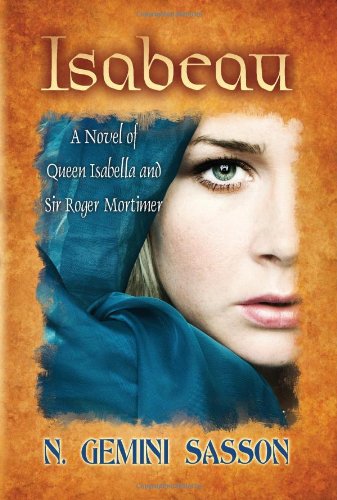

The marriage of Isabella of France and Edward II of England in 1308 is a union meant to secure lasting peace. For years, Isabella is a loyal wife, who repeatedly salvages her husband's kingship, even as she endures his neglect. When she finally speaks out against Edward's favorite, Lord Hugh Despenser, her income, lands and children are taken from her. In an age when women are not supposed to openly defy their husbands, Isabella vows to get her children back and have her revenge on Despenser -- no matter what the cost.
Imprisoned in the Tower of London for leading a rebellion against King Edward, Mortimer escapes with Isabella's help and finds refuge in the French court. But when Isabella arrives in Paris to negotiate a peace treaty, it is a temptation the ambitious Mortimer cannot resist."
Click on the 'Enter to win' link above to put your name in the hat for a free, signed copy of my latest release: Isabeau, A Novel of Queen Isabella and Sir Roger Mortimer. If you're eager to start reading, Isabeau is now available in paperback at Amazon.com, Amazon.co.uk and Barnes and Noble. Or, if you prefer to save some trees and read it on your e-reader, you can find it at Amazon.com (Kindle), Amazon.co.uk (Kindle), Barnes and Noble (Nook), or Smashwords.com (Epub, LRF and PDB).
The giveaway for The Crown in the Heather resulted in 1147 people signing up to win that book, which was pretty darn exciting on this end. To discover more free book giveaways at Goodreads, go here. I've signed up for a few myself, but haven't gotten lucky yet :( . Whenever they're selling raffle tickets somewhere, I make my husband buy them by the arm stretch. He has a pretty good winning percentage and we've hauled home some valuable loot. I gave up after about 20 tries when I hadn't even won the squeaky toy at the dog show. There's a reason why I don't play the lottery.
I meant to start the giveaway for Isabeau sooner, but complications with my web host have bogged me down lately (see previous post). After several requests to tech support which resulted in some very colorful expletives on my end and a bloody computer screen where I banged my head repeatedly, I decided to move on.
So, I'm in the process of transferring to GoDaddy.com who, BTW, replied to my help request within two hours and even called me to clarify a couple of things and see if I had any questions. Yes, I spoke to a real person. And he didn't even use computer-ese. And he ended up saving me $30. I was so pleasantly shocked by their great customer service, that before the guy could end the phone call I gushed at him for a good long minute. I think it made his day!
Hopefully, I'll get my web site back up and running by the end of the week and I can get back to writing in order to get the next book ready. Who knew you practically had to have a degree in computer science to be an author?
Until later,
Gemi
Friday, September 17, 2010
On Being a Writer in the Age of the Internet

Long gone are the days when writers scribbled away on clackety typewriters in self-imposed solitude. To be a writer today, you have to wear many hats. And to be a successful writer, it helps if you're not an anti-social, reclusive technophobe.
Earlier this week I discovered that my web host, in its zeal to 'update' everything, has somehow misdirected both the domain names I own: the one for my author site and the one for my Australian Shepherd kennel. One day, everything was there exactly as I had painstakingly designed it and the next . . . well, things are . . . missing. Attempts to communicate with tech support have resulted in them spewing back technical gibberish which may as well have been Swahili. And this during the week that I'm releasing the paperback edition of Isabeau, A Novel of Queen Isabella and Sir Roger Mortimer, and when a front page article about me and my books appeared in the local community paper.
Can you say 'bad timing'?
Thank goodness there are still other ways to stay in touch with and provide information for readers, like YouTube, Goodreads, Twitter, an Amazon author page and e-mail (please excuse the shameless links I've slipped in there while my web is on vacation). But this (hopefully) temporary crisis made me realize how reliant authors are on the internet these days. I, for one, did not realize when I first sat down to write stories over a decade ago that I would need to became a semi-expert in the arts of social media and web site building. While I love picking out artsy fonts and getting my page colors to be all matchy-matchy, if you start talking about things like 'file transfer protocol' you may notice me sticking my fingers in my ears and going 'la-la-la-la-la-la'.
The truth is: I learn enough to get by. Sometimes I need help. Bless husbands whose best friends are computer engineers. And writing buddies who mentor me in the etiquette and rituals of Tweeting and Blogging.
The internet provides numerous ways to reach potential readers and . . . the internet also takes time away from writing. Thus the dilemma. So hone your writing first; then find ways to get your name out there. You can't write or edit if you're tweeting all day long; but no one will know you exist if you don't have some kind of internet presence. Is it possible to sell lots of books while remaining incognito? Hmm, possibly, if you have a major publisher pumping $$$ into publicity or Oprah selects your book for her book club. Good luck with that.
One of my favorite blogger-writers (who I incidentally discovered on Twitter) is author Jody Hedlund. Her first book, The Preacher's Bride, is due out in October from Bethany House Publishers. Jody has created a substantial following through her informative posts. She talks candidly about everything from platform building to time management for writers. By serving as a filter for helpful information, Jody has succeeded in building a name for herself and consequently an audience that will be eagerly awaiting her book's release.
Still, blogging, tweeting or a slick web site are not the only ways to connect to potential readers. Many other writers simply interact with readers and other writers on a personal level on various forums, like Kindleboards, which is a closely moderated site that does not allow for obnoxious plugging that might alienate readers who are there purely to discuss books or their newest Kindle acquisition. At some point, a reader or book blogger tries their book, likes it and enthusiastically endorses it. Then, the proverbial snowball of success starts rolling as the book rises up through the ranks by word of mouth to compete with traditionally published bestselling authors. Some recent examples are Amanda Hocking, Karen McQuestion, David Dalglish and David McAfee, just to name a few. This isn't going to happen if the book doesn't strike a cord with certain readers. In other words, being social in itself doesn't lead to success, but paired with a well-written book, the potential is there for that to happen.
It has been said many times that "Luck is when preparation meets opportunity". Writers today can't neglect their writing (preparation), nor can they ignore the great equalizer of opportunity that the internet provides.
Happy writing,
Gemi
Wednesday, September 15, 2010
Interview with Ann Weisgarber
 I first met author Ann Weisgarber at the Historical Novel Society conference in Chicago in June of 2009. Actually, I met her husband first when I sat down next to him at one of the many wonderful sessions offered at the conference. Somehow, Rob and I got to talking and it turned out he and his wife were originally from Kettering, Ohio, less than half an hour from where I live, and they had both graduated from Wright State University in Dayton, as I had. Afterwards, he introduced me to Ann. I think it was just serendipity that I bumped into them, because it led me to eventually read Ann's novel, which instantly became one of my all-time favorite works of historical fiction ever.
Ann's debut novel, The Personal History of Rachel DuPree, has been named Best Work of Fiction by the Texas Institute of Letters, longlisted for the Orange Prize and shortlisted for The Orange Prize for New Writers. Quite a list of accolades for a novel that was originally passed over by several American publishers. Happily, the novel found a home with a U.K. publisher and has recently been released by Viking in the U.S.
Following is an interview Ann did for me which originally appeared over at the Historical Novel Review Blog:
• How did you become interested in writing about African American ranchers in South Dakota?
I’ve always loved the West and admire the determined spirit of the people who call it home. I knew there were African-American cowboys, and I had visited a few historical forts where black troops had been posted during the late 1800’s. I didn’t know anything about African-American settlers, though, until I happened to see a photograph of a woman sitting in front of a sod dugout. The photo wasn’t labeled, but from the background the location could have been Nebraska or one of the Dakotas. I was intrigued for several reasons. This unnamed woman was alone, and she was an African-American. I did a little digging and found John Ravage’s Black Pioneers. His non-fiction book was filled with accounts of black settlers in the West.
This was new history for me, and that was exciting. But it was more than that. I couldn’t stop thinking about the woman in the photograph. She was alone in the middle of a wide open stretch of land. I didn’t know her name, and I didn’t know where she lived, but I knew this: she had a story that needed telling. I decided to do that for her.
• How did you research this novel? Did you spend time in the locations you wrote about?
I did the research in bits and pieces. I’d write a scene and realize that I didn’t know anything about the details. For instance, Isaac was posted at Ft. Robinson, Nebraska. This meant I had to research the fort and the cavalry units. When I discovered that the Ninth Cavalry served as reinforcements at Wounded Knee Creek, I then had to research the massacre. From there, I researched the relationship between Buffalo Soldiers and Indians. After that, I read about Pine Ridge Reservation. One piece of information often led to a new idea. Many times the research shaped the book.
I did have a four-week writing residency at Badlands National Park, but I did very little writing while I was there. Instead, I talked to people who lived in the area, I visited Ft. Robinson, and I went to Lead to see the gold mine. I was in the Badlands during a three-day windstorm with gusts so strong that it was impossible to walk upright. There was an electrical storm where the night sky turned white and stayed white for seconds at a time. Best of all, the residency was an opportunity to experience the quiet beauty of the Badlands.
I returned to the Badlands one other time, but that was only for a few days. That was long enough to renew my commitment to finish the manuscript.
• Rachel’s voice is so strong and clear in this story. Did you find it challenging to take on the voice of an African American woman from the early 20th century?
Thank you. It was a challenge and that was one reason why it took so long to write the book. I had to step back in time and imagine a point of view very different from my own. Reading about historical figures such as Ida B. Wells Barnett and Booker T. Washington helped. But it seems to me that assuming a different voice is nothing new for people who write historical fiction. Many writers put aside the “Can I?” and “Should I?” questions. It’s a matter of connecting with the characters on an emotional level. In my case, I was determined to give the unnamed woman in the photograph a story. I wanted to do the best I could. That was my focus.
• Every author has a unique path to publication. Can you tell us a little about yours?
The book -- an American story -- was first published in the UK and then in France. Prior to any of that, I had an agent who did her best to find a U.S. publisher. No one was interested. Several editors said the story was too quiet, and I took that to mean the novel wasn’t ready. My agent lost interest, but we parted on good terms. I went back to page one and started another round of revisions.
Meanwhile, I read about Macmillan New Writing in Poets & Writers. The imprint, a division of Pan Macmillan in the UK, was willing to publish new writers who did not have agents. I sent the manuscript to MNW. It was a long shot. The imprint received thousands of manuscripts and printed twelve novels a year. Eleven weeks later, Will Atkins, the editor, sent an e-mail. He liked the novel.
Eight months after it was published in the UK, it was nominated for the Orange Prize, a literary prize for women writers. A month later, it was nominated for the Orange Award, a prize for new writers. In the States, the Texas Institute of Letters awarded it the Best Work of First Fiction prize.
The nominations in the UK and the prize in Texas opened the door for Rachel DuPree. Pan Macmillan sold the U.S. rights to Viking, an imprint of Penguin Group. It’s a great match for me. My editor, John Siciliano, and the team believe in the book.
The book came to the U.S. through the back door, but I wouldn’t change a thing about my process. This was how it was meant to be.
• What’s next for you?
I'm currently working on a novel that takes place in 1900 in Galveston, Texas. The plot revolves around a college–educated woman who marries a dairy farmer. The story begins a month before the 1900 Storm, the historical hurricane that killed more than six thousand people.
• Where can readers find out more about you and your book?
My website is www.annweisgarber.com. There, readers will find my e-mail address and they are welcome to write me. They’ll also find the first few pages of The Personal History of Rachel DuPree as well as a few articles about the historical facts behind the book. Under Book Clubs, readers can find questions for book discussion groups.
Happy reading,
Gemi
Subscribe to:
Posts (Atom)