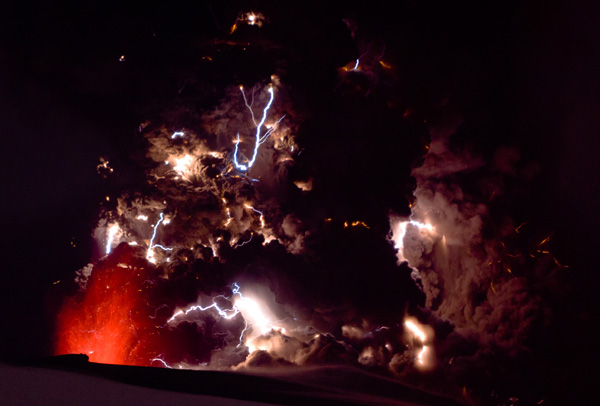
(I've long had a fascination for geologic events, particularly volcanic eruptions. The powerful forces behind these cataclysmic events often have far-reaching and long-lasting effects. They alter the earth, destroy life and even entire civilizations. Today, even though we still can't predict them, at least we understand what is going on beneath the earth's surface. Imagine living in an age when volcanoes were not only unpredictable, but mysterious entities. My talented author-friend Rebecca Lochlann deals with this in her newly released book, The Thinara King, which I highly recommend. I asked her to tell us some more about it. So, welcome, Rebecca!)
*****
The island in
the Mediterranean nowadays called Santorini has had many names
throughout the centuries. One of the oldest known names, and the one I use, is Callisti.
In ancient Greek, it means “The Most Beautiful,” and is alternately
spelled Kalliste.
Strongyle,
another of Santorini’s ancient names, meant, “The Round One.”
Thera, yet another
name long used for this volcanic island, can be translated as “Fear,” which, as
it turns out, was rather prophetic, as is the name of the central mountain,
rumored by some to be Alcmene,
meaning “Wrath of the Moon.”
Book number two of
my series, The Thinara King, jumps right in the middle of this famed volcanic eruption on
Callisti.
For many years,
until “super” volcanoes
were more clearly understood, this eruption was considered the worst in human
history. It was so enormous, so destructive, (categorized as a Plinian type
event) that it made the eruption of Tambora look like a tiny belch in the
earth. It would have made the Mt. Saint Helen’s eruption seem like nothing more
than a brief, sleeping baby’s gasp.
As scientists
become more adept at studying the effects of volcanoes, (and it’s impressive
how much they’ve learned about the Santorini volcano, even though it happened
so very long ago), they have conjectured that the repercussions of this event
went clear round the world, and probably affected the earth’s climate for many
years. From the depth of the ash on the sea floor, they have determined that
the worst damage done to Crete, a mere seventy miles away, was on the east
side. With improved methods and the study of more recent eruptions, there are
now conjectures that the pyroclastic flow (the most dangerous, murderous part
of an eruption) could very well have traveled on top of the water clear to
Crete. The idea that such a thing could happen is amazing, and is merely
theory, not proven. But that’s how huge this eruption was. Tsunamis of course
came along after, and devastated the entire coast; there are theories that the
tsunami which struck the northern coast managed to flow clear into the city of Knossos.
Charles Pellegrino, in his book Unearthing
Atlantis, says: “Within hours of the Theran upheaval of 1628 BC., death
rolled into southern Turkey on the tongue of a tsunami. Two peninsulas jutting
into the Aegean Sea confined the wave as if between the prongs of a mighty
tuning fork, building it higher and higher and ultimately funneling it thirty
miles inland. To penetrate so far, it had to be eight hundred feet tall when it
hit the shore.” (Pellegrino, C. Unearthing
Atlantis. New York: Avon, 1991)
One small bit of
positive news: recent theories state that most of the populace on Santorini
actually managed to escape the island before it blew into the heavens, leaving
nothing but a sliver (part of which is again beginning to send out ominous
messages). The volcano gave them warning, and they apparently heeded this
warning. Since Callisti is considered by many to be an outpost of Crete, it’s
no leap of logic to assume most of the refugees would go there, and that’s what
happens in my book.
As awful as this
eruption was, it did not end Cretan society. I have no doubt many died of the
aftereffects, like starvation, ash suffocation, etc. But the Cretan
civilization did eventually recover. Yes, these intrepid, hardy people managed
to survive and even thrive again after this indescribable event. But at some
point, later, the wondrous Bronze Age society of Crete (or Kaphtor) did
disappear. This segment of my series, (a trilogy) offers one possible reason
why, sets the starting point for the later books, and initiates a more familiar
history—one that might never have occurred had Crete survived, retaining its original
power and influence.
From everything Plato
said about Atlantis, there
is no doubt in my mind Thera is that fabled place.
Here is an
excerpt from deep within The Thinara
King.

Twilight
fell. Chrysaleon made a fire from dead olive branches. The last glow of
sunlight transformed gray clouds to scarlet and lavender, with hints of green
and yellow. Beneath this magnificence he constructed a pyramid of stones and
shot an unwary hawk from the sky. He burned its thighs in offering and knelt
beside his cairn, clenching the necklace in his fist.
“Poseidon,”
he said. “Walk with me. Lead me to Aridela. Make our bond unbreakable. Help me
slay Harpalycus and bring an end to the king-sacrifice.” He peered into the
heavens. “Make me this great-year-king, Horse Tamer, and I will present you
with the rich island of Crete. I will cover this land with temples and fill
each one with your image.”
A
sudden gust of wind shot a fan of sparks into the dimming indigo sky.
He
took it for the answer he wanted. Chrysaleon wrapped himself in the cloak Neoma
had given him. “Bring Aridela home,” she’d begged, clutching his arm. “I miss
her. I don’t think she even knows I’m alive.” The stone that struck her during
the worst of the Destruction had left a noticeable depression in her forehead,
like a large, out-of-place dimple, and ongoing headaches forced her to spend
time in darkened seclusion nearly every day.
He
stared at his fire, sleepless, thinking of Aridela, longing for her. A memory
crept before him, one he’d forgotten, from his time near death in the cell at
Labyrinthos.
In
his starved, thirsty mind, he’d experienced a vision of Menoetius transforming
into a black bull, the enormous bad-tempered kind Cretans used in their ring.
The beast gored him and as he lay gasping, his lifeblood seeping away, Aridela
came to stand beside the bull, resting her hand on his neck in an intimate
manner. She had looked down upon Chrysaleon without any emotion.
“No,”
he’d whispered, and he did so again now, his teeth and hands clenching as he
gazed into the cold night sky. “Menoetius won’t defeat me.”
He
fell asleep at last, but during the night’s blackest point, he was awakened by
the earth shuddering. Small creatures scurried; rocks scraped, rolled, and
tumbled. His horse shied and nickered. Farther away, he heard ominous, eerie
echoes as an avalanche of boulders crashed into one of Crete’s many precipitous
gorges.
He
stared into the night toward the mountains, aching to be among them.
I’m coming, Aridela. I will find
you.
*****
The Year-god’s Daughter: Book One of The Child of the Erinyes
The Thinara King: Book Two of The Child of the Erinyes
In the Moon of Asterion: The conclusion
of the Bronze Age trilogy (available by the end of 2012)
Website: http://rebeccalochlann.com
Amazon Rebecca
Lochlann page: http://tinyurl.com/73u82kg
Blog and
excerpts: http://rebsthoughtsandinspirations.blogspot.com/
Thanks for visiting with us, Rebecca!
Happy reading,
Gemi


